Saturday, November 12, 2016
Wednesday, July 22, 2015
The (Real) Cost of Pretrial Justice
What is the (Real) Cost of Pretrial Justice? Here's the answer:
More Days in Jail = Higher Risk of Crime
(Originally published in the Public Welfare Foundation's Newsletter)Jails are very expensive to build and maintain, but they are often seen as worth the investment since they keep criminals off the street. However, many communities are surprised to find that when they look at who is actually in their jail, the population is predominately low-level, non-violent defendants who simply could not post their bond. In the short term, the community incurs the cost of incarcerating these individuals unnecessarily, but the long-term costs may be more significant. New research from the Laura and John Arnold Foundation has shown that incarceration itself is correlated with an increased likelihood that low risk defendants will commit future crimes. In (Lowenkamp, C.T., VanNostrand, M, and Holsinger, A. (2013). The Hidden Costs of Pretrial Detention. New York: Laura and John Arnold Foundation.
In terms of the costs of new crime and victimization, as well as the cost of incarceration itself, communities benefit from either not incarcerating these individuals in the first place, or releasing them as quickly as possible from jail.
An Effective and Efficient Solution
Fortunately, the science of pretrial justice offers an answer that protects public safety and minimizes costs. By assessing the risk defendants pose to public safety, and the likelihood that they will return to court, judges are able to make informed decisions as to who needs to be in jail, and who can safely stay in the community. A continuum of community supervision options can also allow communities to best respond to the risk that a defendant poses—and at a fraction of the cost of a jail bed.
Time is of the essence, however, and pretrial policy must also address system efficiency. As shown in National Association of Pretrial Services Agencies. (2014) The Patient Protection and Affordable Care Act and the Pretrial System: A “front door” to health and safety. Retrieved on May 20, 2014 from Holder, E. (2011). Attorney General Eric Holder speaks at the the Arnold Foundation research, unnecessary nights in jail have a real public safety cost, so systems must carefully consider how law enforcement makes arrest and booking decisions, and how courts, jails, and pretrial services agencies screen and hold or release defendants.
In addition, the Patient Protection and Affordable Care Act (ACA) creates a unique opportunity for the pretrial system to connect defendants to health services in the community. Often, jails become de facto providers of physical and behavioral health services, at a very high cost, and upon release defendants frequently relapse due to lack of care. To break the vicious cycle, several communities have begun enrolling defendants in Medicaid, allowing them to access physical and behavioral health services in the community, receive services at a lower cost than through the jail, and ideally avoid future arrest and conviction.
Sunday, December 7, 2014
Web Based Interventions Seen as Effective in Treating Substance Use Problems
TES is a web-based version of the Community Reinforcement Approach plus Contingency Management, a packaged approach with demonstrated efficacy. The National Institute on Drug Abuse (NIDA), part of the NIH, funded this study.
TES consists of 62 interactive modules that teach patients how to achieve and maintain abstinence from drug use and includes prize-based motivational incentives to encourage adherence to treatment. Patients given TES were less likely to drop out of treatment than those in the control group. Also, the web-based intervention helped patients stay abstinent from drug use, even those who were not abstinent at the beginning of the study. With such findings, web-based interventions like TES are promising additions to drug abuse treatment.
This approach, which combines skills-oriented counseling and contingency management in an Internet-delivered behavioral intervention, produced high rates of abstinence from drugs and heavy drinking among patients with a good prognosis (those who entered the study with positive urine drug or breath alcohol screen) but doubled the likelihood of abstinence among patients with an otherwise poor prognosis.
Computer-delivered interventions have the potential to improve access to quality addiction treatment care. The objective of this study was to evaluate the effectiveness of the Therapeutic Education System (TES), an Internet-delivered behavioral intervention that includes motivational incentives, as a clinician-extender in the treatment of substance use disorders.
Adult men and women (N=507) entering 10 outpatient addiction treatment programs were randomly assigned to receive 12 weeks of either treatment as usual (N=252) or treatment as usual plus TES, with the intervention substituting for about 2 hours of standard care per week (N=255).
TES consists of 62 computerized interactive modules covering skills for achieving and maintaining abstinence, plus prize-based motivational incentives contingent on abstinence and treatment adherence. Treatment as usual consisted of individual and group counseling at the participating programs. The primary outcome measures were abstinence from drugs and heavy drinking (measured by twice-weekly urine drug screens and self-report) and time to dropout from treatment.
Compared with patients in the treatment-as-usual group, those in the TES group had a lower dropout rate and a greater abstinence rate. This effect was more pronounced among patients who had a positive urine drug or breath alcohol screen at study entry (N=228).
Internet-delivered interventions such as TES have the potential to expand access and improve addiction treatment outcomes. Additional research is needed to assess effectiveness in non-specialty clinical settings and to differentiate the effects of the community reinforcement approach and contingency management components of TES.
Tom Wilson Counseling Online Alcohol Classes currently uses similar evidenced based practices inclusing cognitive behavioral techniques, motivational enhancement therapy and stages of change theory.
Saturday, November 29, 2014
California Courts Accept Tom Wilson Counseling Online DUI Classes for Out of State DUI Offenders
A recent survey of California courts that approved Tom Wilson Counseling Center's online DUI classes for out of state offenders was recently published and made available in graphical form for Attorneys and probation officers at a California Probation Association Conference. Here are the results:
Thursday, July 24, 2014
Online Class Meets California Penal Code 1000 Deferred Entry of Judgment Drug Diversion Program
Many non-violent drug offenders would benefit more from treatment and education than from jail and a criminal record.
Penal Code 1000 PC is California's Deferred Entry of Judgment ( DEJ ) program
allows offenders an alternative to prison or other criminal
punishments. It is a drug diversion program that allows eligible
defendants to be diverted out of the criminal court system and into a
drug rehabilitation program.Tom Wilson Counseling Center offers an Online 26 Hour Deferred Entry of Judgment Drug Diversion Class for out of state residents who receive a drug charge offense in the State of California and cannot find other in-person solutions or alternatives.
Ask your attorney to determine if you are eligible.
Overview of Penal Code 1000 PC
Deferred Entry of Judgment, defined in Penal Code 1000 PC, allows eligible defendants the opportunity to have their criminal proceedings suspended while they attempt to complete a drug treatment program.
Generally speaking, the defendant enters a guilty plea to the charge(s). If the judge determines that the defendant is a good candidate for drug diversion, he/she will suspend the criminal proceedings, typically for a period of 18 months, although it may be as long as three years, while the defendant participates in a drug rehabilitation program.
A drug rehabilitation program is one that has been certified or deemed credible and effective by the applicable county drug program administrator. The defendant may request to be referred to a program in any county, as long as the program meets this criteria. All programs include at least some of the following curriculum:
- an initial assessment of the defendant,
- a minimum of 20 hours of effective education and/or counseling, and
- an exit conference which shall reflect the defendant's progress during his/her participation in the program.
However, if the judge does not believe that the defendant would benefit from treatment or the defendant does not successfully complete his/her course of treatment, the judge will impose sentence on the charge(s).
Eligibility
Before a defendant can participate in California's deferred entry of judgment program, he/she must be eligible to do so. Eligibility is primarily based on two factors:
- the charged offense(s), and
- the defendant's personal history.
California drug diversion is only offered in connection with certain qualifying offenses. If your charged offense/offenses are not specifically listed under Penal Code 1000 PC, you will not be able to participate in this deferred entry of judgment program.
There are essentially two criteria for these offenses:
- they must involve personally possessing or using drugs as opposed to possessing them for sale or actually selling them, and
- the crime must not involve any allegations of violence or threatened violence.
- Health and Safety Code 11377 HS and Health and Safety Code 11350 HS California's laws against personal possession of a controlled substance
- Health and Safety Code 11357 HS California's law against possession of less than one ounce of marijuana
- Health and Safety Code 11358 HS California's law against cultivating marijuana 10 (if you can prove that you only cultivated the marijuana for your own personal use)
- Health and Safety Code 11364 HS California's law against possessing drug paraphernalia
- Health and Safety Code 11365 HS California's law against knowingly being in a place where drugs are being used
- Health and Safety Code 11550 HS California's law against being under the influence of a controlled substance
- Health and Safety Code 11368 HS California's law against forging or presenting a forged prescription to obtain drugs (if you can prove that the acquired controlled substances were exclusively for your personal use)
- Vehicle Code 23222(b) VC California's law against driving while in possession of marijuana
- Penal Code 647(f) PC California's drunk in public law (if you were under the influence of drugs or drugs and alcohol, as opposed to just alcohol)
- Penal Code 653f(d) PC California's law against soliciting drug sales or transportation17 (if you can prove that you only "solicited"…that is, encouraged…another person to engage in these activities so that you could exclusively acquire drugs for your personal use)
cocaine, heroin, peyote, gamma-hydroxybutyric acid (GHB), ecstasy (X), ketamine (Special K), methamphetamines, marijuana, certain hallucinogenic substances, such as phencyclidine ("PCP"), and even certain prescription drugs such as codeine, and hydrocodone (Vicodin).
Penal Code 1000 PC California's DEJ program is not only applicable to a much wider variety of crimes than its counterpart California Proposition 36 but is also much less restrictive. This is because PC 1000 allows convictions for certain offenses that Prop. 36 does not.
These offenses include, for example,
- cultivating marijuana for your personal use, and
- forging prescriptions for your personal use.21
Your personal history
Even if the charged offense qualifies you for DEJ, you must still prove that you are personally eligible for drug diversion. In order to qualify, you cannot have;
- any prior drug-related convictions,
- had your probation or parole revoked without completing your terms and conditions,
- participated in a drug diversion or DEJ program within five years prior to the alleged commission of the charged offense, and
- any prior felony convictions within five years prior to the alleged commission of the charged offense.22
Sentencing in Connection with Deferred Entry of Judgment
Once the judge determines that you are a good candidate for Penal Code 1000 PC California's deferred entry of judgment program, you must enter a guilty plea to the applicable charge(s). At that point, you waive time for the pronouncement of judgment, which means that you give the court permission to postpone sentencing, so that you can participate in drug diversion.
Drug treatment
At the court's request, the court's local probation department will conduct an investigation as to what course of treatment is most appropriate. It will consider factors such as the defendant's age, any employment and/or service records, education, community and family ties, and any prior drug history (including any prior treatment history).
But regardless of what the probation department recommends, the ultimate decision as to what type of treatment should be offered is up to the judge.
If the prosecutor, probation department or the court believes that you are failing to adhere to the program, are not benefiting from treatment, have been convicted of a) a felony, or b) a misdemeanor that reflects your propensity for violence, or c) have engaged in any criminal activity that renders you unsuitable for DEJ, the judge may enter judgment on the guilty plea and will set a sentencing hearing to determine the appropriate punishment for the charge(s). However, if you successfully complete the program, the court is required to dismiss the charge(s).
Successful Completion of DEJ
What makes drug diversion so attractive is the fact that your criminal charge(s) will be automatically dismissed as long as you successfully complete the program. Once your charges are dismissed, it is almost as if the arrest legally never occurred.
There is an exception to this general principle. You and the Department of Justice must disclose the arrest if you apply to become a peace officer. Other than that, when you successfully complete your deferred entry of judgment program, "the arrest upon which the judgment was deferred shall be deemed to have never occurred". This means that you can truthfully state that you have never been arrested or granted deferred entry of judgment for the offense, and the arrest record cannot be used in any way to affect your employment or a professional license or certificate.
ALL classes developed and monitored by Tom Wilson, a Licensed Clinical Professional Counselor who is also a Certified Alcohol and Substance Prevention Specialist. Tom is the author of "Taming Anger and Aggression", an anger management program which has been taught to hundreds of people at the counseling center over the last twelve years. He specializes in adapting evidence-based substance abuse prevention programs for delivery through the web and other electronic media.
Friday, June 27, 2014
Drug Diversion for Deferred Entry of Judgment
Monday, March 3, 2014
California Online Deferred Entry of Judgment PC 1000 Class to Suspend Criminal Prosecution for First Offenders
Online Deferred Entry of Judgment Class to meet Drug Diversion PC 1000 Program Court Requirements for First Time Offenders
Meets California's PC1000 Court Requirements
Complete Online Drug Diversion Program for Court Requirements with a Certified Substance Abuse Prevention Specialist. This class is for first time drug offenders, such as possession of marijuana or a controlled substance and/or paraphernalia. If a first offense drug defendant has an otherwise clean criminal record, judges generally will find a defendant eligible for the deferred entry of judgement program or drug diversion class without requiring a formal eligibility evaluation. This drug awareness class is also known as a Deferred Entry of Judgment or PC 1000 class in California. Get court approval before enrolling.
Tom Wilson Counseling Center and TeleHealth has been providing approved classes online since 2004 for DUI, Alcohol, Drug, Anger Management, Conflict Management, Petty Theft Shoplifting, Traffic Safety, Parent Education, Thinking Errors, Cognitive Self Change, and DUI, Alcohol, Drug Evaluations. Instructor credentials can be viewed here: www.tomwilsoncounseling.com
Contact us at support@twccsolutions.com or call Toll Free 1.877.368.9909 during office hours; Monday-Friday, 9am-5pm MDT/MST with questions. If you call before or after our regular office hours, please leave a message and we will return your call as soon as possible.
Thursday, July 18, 2013
Pageant queen, 13 others cited for possessing alcohol | Fort Mill Times - Fort Mill, SC
Early intervention needed here to prevent kids form developing more serious alcohol abuse problems.
An ordinance for Pre-Trial Diversion went before Opelika Council - OANow.com: Opelika
This ordinance will be a great way to divert low-risk offenders away from the overburdened judicial system in Alabama. This is similar to the pre-trial diversion program used in California for first time drug offenders called the deferred Entry of Judgment PC1000 program. California now uses online drug awareness classes to help young, low-risk drug offenders meet their court obligations in a timely manner so that first offense drug charges can be dismissed upon completion of their program.
Monday, June 17, 2013
Drug offense hearings in California may be delayed due to budget cuts
Deferred entry of judgment, defined in Penal Code 1000 PC, allows eligible defendants the opportunity to have their criminal proceedings suspended while they complete a drug treatment program.
Most of the time, the defendant enters a guilty plea to the charge. If the judge determines that the defendant is a good candidate for drug diversion, he or she will suspend the criminal proceedings. typically for a period of 18 months, although it may be as long as three years while the defendant participates in a drug rehabilitation program. This judgment could be further delayed by the recent California budget cuts that are causing substantial delays for criminal hearings.
A drug rehabilitation program is one that has been certified or deemed credible and effective by the applicable county drug program administrator. The defendant may request to be referred to a program in any county, as long as the program meets this criteria. However, if the defendant is not a resident of California, the judge may approve an online drug diversion program.
If the defendant successfully completes the program, the judge dismisses the charges and. with only a few exceptions, the defendant may truthfully state that he or she has never been arrested for the charged offense.
However, if the judge does not believe that the defendant would benefit from treatment, or the defendant does not successfully complete his or her course of treatment, the judge will impose sentence on the charges.
In many cases, your attorney or the judge will recommend court approved
online Drug Diversion Program as part of your sentence. Tom Wilson Counseling Center provides online DUI classes specifically designed for out-of-state
residents that received a DUI in the State of California.- 100% online and available 24/7
- Secure registration and payment
- Convenient and Confidential
Additional Sources:
http://www.shouselaw.com/drug-diversion.html
Friday, April 12, 2013
Online Drug Diversion Class to Suspend Criminal Prosecution for First Offenders
Wednesday, January 30, 2013
Deferred Entry of Judgment Class to Suspend Criminal Prosecution for First Offenders
Court Procedures for Deferred Entry of Judgment in California
At the DEJ hearing the judge will determine eligibility for the diversion program. If found eligible by the judge, program requirements will be described to the defendant, including the program length and the consequences of not enrolling or completing the program.
In court, the defendant is advised that he or she must plead guilty to the charges, and pay a restitution fee of not less than $100 and not more that $1000.
The defendant is advised that they are responsible for treatment, education or rehabilitation costs, and also for reasonable probation fees and costs.
The defendant is advised that if he or she successfully completes the program, the criminal charges will be dismissed and the arrest for the charge(s) deemed to have never occurred.
However, if the defendant fails to enroll in the diversion program or fails to comply with or complete the program requirements, diversion will be terminated and criminal proceedings against the defendant will proceed.
ALL classes developed and monitored by Tom Wilson, a Licensed Clinical Professional Counselor who is also a Certified Alcohol and Substance Prevention Specialist. Tom is the author of "Taming Anger and Aggression", an anger management program which has been taught to hundreds of people at the counseling center over the last twelve years. He specializes in adapting evidence-based substance abuse prevention programs for delivery through the web and other electronic media.
Friday, November 16, 2012
Drug Use and Diversion in the US
2010 National Survey on Drug Use
The four categories of prescription-type drugs (pain relievers, tranquilizers, stimulants, and sedatives) cover numerous medications that currently are or have been available by prescription. They also include drugs within these groupings that originally were prescription medications but currently may be manufactured and distributed illegally, such as methamphetamine, which is included under stimulants. Respondents are asked to report only "nonmedical" use of these drugs, defined as use without a prescription of the individual's own or simply for the experience or feeling the drugs caused. Use of over-the-counter drugs and legitimate use of prescription drugs are not included. NSDUH reports combine the four prescription-type drug groups into a category referred to as "psychotherapeutics."
Estimates of "illicit drug use" reported from NSDUH reflect the use of any of the nine drug categories listed above. Use of alcohol and tobacco products, while illegal for youths, is not included in these estimates.
In 2010, an estimated 22.6 million Americans aged 12 or older were current (past month) illicit drug users, meaning they had used an illicit drug during the month prior to the survey interview (Figure 2.1). This estimate represents 8.9 percent of the population aged 12 or older.
Figure 2.1 Past Month Illicit Drug Use among Persons Aged 12 or Older: 2010
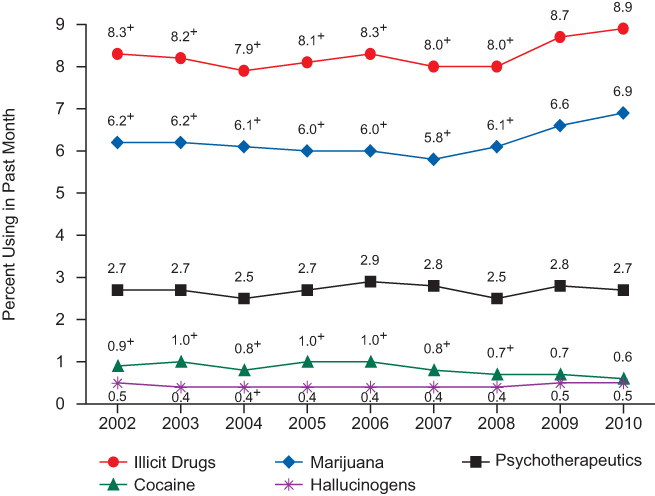
The overall rate of current illicit drug use among persons aged 12 or older in 2010 (8.9 percent) was similar to the rate in 2009 (8.7 percent), but it was higher than the rates in 2002 through 2008 (Figure 2.2).
Figure 2.2 Past Month Use of Selected Illicit Drugs among Persons Aged 12 or Older: 2002-2010
In 2010, marijuana was the most commonly used illicit drug, with 17.4 million current users. It was used by 76.8 percent of current illicit drug users and was the only drug used by 60.1 percent of them. Also in 2010, 9.0 million persons aged 12 or older were current users of illicit drugs other than marijuana (or 39.9 percent of illicit drug users aged 12 or older). Current use of other drugs but not marijuana was reported by 23.2 percent of illicit drug users, and 16.7 percent used both marijuana and other drugs.
The number and percentage of persons aged 12 or older who were current users of marijuana in 2010 (17.4 million or 6.9 percent) were similar to the estimates for 2009 (16.7 million or 6.6 percent), but the estimates in 2010 were higher than those in 2002 through 2008. Between 2007 and 2010, the rate increased from 5.8 to 6.9 percent, and the number of users increased from 14.4 million to 17.4 million.
An estimated 9.0 million people aged 12 or older (3.6 percent) were current users of illicit drugs other than marijuana in 2010. The majority of these users (7.0 million persons or 2.7 percent of the population) were nonmedical users of psychotherapeutic drugs, including 5.1 million users of pain relievers, 2.2 million users of tranquilizers, 1.1 million users of stimulants, and 374,000 users of sedatives.
The number and percentage of persons aged 12 or older who were current nonmedical users of psychotherapeutic drugs in 2010 (7.0 million or 2.7 percent) were similar to those in 2009 (7.0 million or 2.8 percent) and to those in 2002 (6.3 million or 2.7 percent) (Figure 2.2).
The number and percentage of persons aged 12 or older who were current nonmedical users of stimulants in 2010 (1.1 million or 0.4 percent) were similar to those in 2009 (1.3 million or 0.5 percent) (Figure 2.3).
The number and percentage of persons aged 12 or older who were current users of methamphetamine in 2010 (353,000 or 0.1 percent) were similar to those from 2007 through 2009, but lower than those from 2002 through 2006. The previous numbers and percentages were 502,000 (0.2 percent) in 2009, 314,000 (0.1 percent) in 2008, 529,000 (0.2 percent) in 2007, 731,000 (0.3 percent) in 2006, 628,000 (0.3 percent) in 2005, 706,000 (0.3 percent) in 2004, 726,000 (0.3 percent) in 2003, and 683,000 (0.3 percent) in 2002.
The number and percentage of persons aged 12 or older who were current users of cocaine in 2010 (1.5 million or 0.6 percent) were similar to those in 2009 (1.6 million or 0.7 percent), but lower than those from 2002 through 2008. The previous numbers and percentages were 1.9 million (0.7 percent) in 2008, 2.1 million (0.8 percent) in 2007, 2.4 million (1.0 percent) in 2006, 2.4 million (1.0 percent) in 2005, 2.0 million (0.8 percent) in 2004, 2.3 million (1.0 percent) in 2003, and 2.0 million (0.9 percent) in 2002.
The number and percentage of persons aged 12 or older who were current users of hallucinogens in 2010 (1.2 million or 0.5 percent) were similar to those in 2009 (1.3 million or 0.5 percent). These include similar numbers and percentages for current users of Ecstasy, with 695,000 (0.3 percent) current users in 2010 and 760,000 (0.3 percent) current users in 2009.
Diversion has become a very popular method of alleviating congested court calendars, while at the same time allowing first-offenders to avoid the blemish of a drug conviction on their record. The program allows offenders to avoid a criminal record by completing drug education or a drug counseling program.
If a first offense drug defendant has an otherwise clean criminal record, judges generally will find a defendant eligible for the drug diversion program without requiring a formal eligibility evaluation.
You must obtain preauthorization from the court before enrolling. Policies may change without notice, and there is no guarantee that you will be approved for online classes by the county courts.
Court Procedures for Deferred Entry of Judgment Program in California
Monday, October 15, 2012
AB 2552 Bill Introduced in California
BILL NUMBER: AB 2552 INTRODUCED
BILL TEXT
INTRODUCED BY Assembly Member Torres
FEBRUARY 24, 2012
An act to amend Section 23152 of the Vehicle Code, relating to
driving under the influence.
LEGISLATIVE COUNSEL'S DIGEST
AB 2552, as introduced, Torres. Driving under the influence.
Existing law prohibits a person who is under the influence of any
alcoholic beverage or drug, or under the combined influence of any
alcoholic beverage and drug to drive a vehicle.
This bill would make it a crime for a person who has any level of
cannabinoids or synthetic cannabinoid compound, as defined, in his or
her blood or urine to drive a vehicle. This bill would establish a
rebuttable presumption that a person had cannabinoids or synthetic
cannabinoid compound in his or her blood or urine at the time he or
she drove a vehicle if the substance is present in his or her blood
or urine at the time of a chemical test performed within three hours
after driving. This bill would impose a state-mandated local program
by expanding the definition of a crime.
The California Constitution requires the state to reimburse local
agencies and school districts for certain costs mandated by the
state. Statutory provisions establish procedures for making that
reimbursement.
This bill would provide that no reimbursement is required by this
act for a specified reason.
Vote: majority. Appropriation: no. Fiscal committee: yes.
State-mandated local program: yes.
THE PEOPLE OF THE STATE OF CALIFORNIA DO ENACT AS FOLLOWS:
SECTION 1. Section 23152 of the Vehicle Code, as amended by
Section 31 of Chapter 455 of the Statutes of 1995, is amended to
read:
23152. (a) It is unlawful for any person who is under the
influence of any alcoholic beverage or drug, or under the combined
influence of any alcoholic beverage and drug, to drive a vehicle.
(b) It is unlawful for any person who has 0.08 percent or more, by
weight, of alcohol in his or her blood to drive a vehicle.
For purposes of this article and Section 34501.16, percent, by
weight, of alcohol in a person's blood is based upon grams of alcohol
per 100 milliliters of blood or grams of alcohol per 210 liters of
breath.
In any prosecution under this subdivision, it is a rebuttable
presumption that the person had 0.08 percent or more, by weight, of
alcohol in his or her blood at the time of driving the vehicle if the
person had 0.08 percent or more, by weight, of alcohol in his or her
blood at the time of the performance of a chemical test within three
hours after the driving.
(c) It is unlawful for any person who is addicted to the use of
any drug to drive a vehicle. This subdivision shall not apply to a
person who is participating in a narcotic treatment program approved
pursuant to Article 3 (commencing with Section 11875) of Chapter 1 of
Part 3 of Division 10.5 of the Health and Safety Code.
(d) It is unlawful for any person who has 0.04 percent or more, by
weight, of alcohol in his or her blood to drive a commercial motor
vehicle, as defined in Section 15210.
In any prosecution under this subdivision, it is a rebuttable
presumption that the person had 0.04 percent or more, by weight, of
alcohol in his or her blood at the time of driving the vehicle if the
person had 0.04 percent or more, by weight, of alcohol in his or her
blood at the time of the performance of a chemical test within three
hours after the driving.
(e) This section shall become operative on January 1, 1992, and
shall remain operative until the director determines that federal
regulations adopted pursuant to the Commercial Motor Vehicle Safety
Act of 1986 (49 U.S.C. Sec. 2701 et seq.) contained in Section 383.51
or 391.15 of Title 49 of the Code of Federal Regulations do not
require the state to prohibit operation of commercial vehicles when
the operator has a concentration of alcohol in his or her blood of
0.04 percent by weight or more.
(f) The director shall submit a notice of the determination under
subdivision (e) to the Secretary of State, and this section shall be
repealed upon the receipt of that notice by the Secretary of State.
(g) It is unlawful for any person who has any level of
cannabinoids or synthetic cannabinoid compound in his or her blood or
urine to drive a vehicle. For purposes of this subdivision,
"synthetic cannabinoid compound" has the same meaning as defined in
Section 11357.5 of the Health and Safety Code. For purposes of this
subdivision, it is a rebuttable presumption that a cannabinoid or
synthetic cannabinoid compound is in a person's blood or urine at the
time of driving the vehicle if the substance is present at the time
of the performance of a chemical test within three hours after
driving.
SEC. 3. Section 23152 of the Vehicle Code, as amended by Section
32 of Chapter 455 of the Statutes of 1995, is amended to read:
23152. (a) It is unlawful for any person who is under the
influence of any alcoholic beverage or drug, or under the combined
influence of any alcoholic beverage and drug, to drive a vehicle.
(b) It is unlawful for any person who has 0.08 percent or more, by
weight, of alcohol in his or her blood to drive a vehicle.
For purposes of this article and Section 34501.16, percent, by
weight, of alcohol in a person's blood is based upon grams of alcohol
per 100 milliliters of blood or grams of alcohol per 210 liters of
breath.
In any prosecution under this subdivision, it is a rebuttable
presumption that the person had 0.08 percent or more, by weight, of
alcohol in his or her blood at the time of driving the vehicle if the
person had 0.08 percent or more, by weight, of alcohol in his or her
blood at the time of the performance of a chemical test within three
hours after the driving.
(c) It is unlawful for any person who is addicted to the use of
any drug to drive a vehicle. This subdivision shall not apply to a
person who is participating in a narcotic treatment program approved
pursuant to Article 3 (commencing with Section 11875) of Chapter 1 of
Part 3 of Division 10.5 of the Health and Safety Code.
(d) It is unlawful for any person who has any level of
cannabinoids or synthetic cannabinoid compound in his or her blood or
urine to drive a vehicle. For purposes of this subdivision,
"synthetic cannabinoid compound" has the same meaning as defined in
Section 11357.5 of the Health and Safety Code. For purposes of this
subdivision, it is a rebuttable presumption that a cannabinoid or
synthetic cannabinoid compound is in a person's blood or urine at the
time of driving the vehicle if the substance is present at the time
of the performance of a chemical test within three hours after
driving.
(d)
(e) This section shall become operative only upon the
receipt by the Secretary of State of the notice specified in
subdivision (f) of Section 23152, as added by Section 25 of Chapter
1114 of the Statutes of 1989.
SEC. 4. No reimbursement is required by this act pursuant to
Section 6 of Article XIII B of the California Constitution because
the only costs that may be incurred by a local agency or school
district will be incurred because this act creates a new crime or
infraction, eliminates a crime or infraction, or changes the penalty
for a crime or infraction, within the meaning of Section 17556 of the
Government Code, or changes the definition of a crime within the
meaning of Section 6 of Article XIII B of the California
Constitution.
Monday, September 17, 2012
California Penal Code 1000 PC Deferred Entry of Judgment Drug Diversion Program
Many non-violent drug offenders would benefit more from treatment and education than from jail and a criminal record.
Penal Code 1000 PC is California's Deferred Entry of Judgment ( DEJ ) program allows offenders an alternative to prison or other criminal punishments. It is a drug diversion program that allows eligible defendants to be diverted out of the criminal court system and into a drug rehabilitation program.Tom Wilson Counseling Center offers an Online 26 Hour Deferred Entry of Judgment Drug Diversion Class for out of state residents who receive a drug charge offense in the State of California and cannot find other in-person solutions or alternatives.
Ask your attorney to determine if you are eligible.
Overview of Penal Code 1000 PC
Deferred Entry of Judgment, defined in Penal Code 1000 PC, allows eligible defendants the opportunity to have their criminal proceedings suspended while they attempt to complete a drug treatment program.
Generally speaking, the defendant enters a guilty plea to the charge(s). If the judge determines that the defendant is a good candidate for drug diversion, he/she will suspend the criminal proceedings, typically for a period of 18 months, although it may be as long as three years, while the defendant participates in a drug rehabilitation program.
A drug rehabilitation program is one that has been certified or deemed credible and effective by the applicable county drug program administrator. The defendant may request to be referred to a program in any county, as long as the program meets this criteria. All programs include at least some of the following curriculum:
- an initial assessment of the defendant,
- a minimum of 20 hours of effective education and/or counseling, and
- an exit conference which shall reflect the defendant's progress during his/her participation in the program.
However, if the judge does not believe that the defendant would benefit from treatment or the defendant does not successfully complete his/her course of treatment, the judge will impose sentence on the charge(s).
Eligibility
Before a defendant can participate in California's deferred entry of judgment program, he/she must be eligible to do so. Eligibility is primarily based on two factors:
- the charged offense(s), and
- the defendant's personal history.
California drug diversion is only offered in connection with certain qualifying offenses. If your charged offense/offenses are not specifically listed under Penal Code 1000 PC, you will not be able to participate in this deferred entry of judgment program.
There are essentially two criteria for these offenses:
- they must involve personally possessing or using drugs as opposed to possessing them for sale or actually selling them, and
- the crime must not involve any allegations of violence or threatened violence.
- Health and Safety Code 11377 HS and Health and Safety Code 11350 HS California's laws against personal possession of a controlled substance
- Health and Safety Code 11357 HS California's law against possession of less than one ounce of marijuana
- Health and Safety Code 11358 HS California's law against cultivating marijuana 10 (if you can prove that you only cultivated the marijuana for your own personal use)
- Health and Safety Code 11364 HS California's law against possessing drug paraphernalia
- Health and Safety Code 11365 HS California's law against knowingly being in a place where drugs are being used
- Health and Safety Code 11550 HS California's law against being under the influence of a controlled substance
- Health and Safety Code 11368 HS California's law against forging or presenting a forged prescription to obtain drugs (if you can prove that the acquired controlled substances were exclusively for your personal use)
- Vehicle Code 23222(b) VC California's law against driving while in possession of marijuana
- Penal Code 647(f) PC California's drunk in public law (if you were under the influence of drugs or drugs and alcohol, as opposed to just alcohol)
- Penal Code 653f(d) PC California's law against soliciting drug sales or transportation17 (if you can prove that you only "solicited"…that is, encouraged…another person to engage in these activities so that you could exclusively acquire drugs for your personal use)
cocaine, heroin, peyote, gamma-hydroxybutyric acid (GHB), ecstasy (X), ketamine (Special K), methamphetamines, marijuana, certain hallucinogenic substances, such as phencyclidine ("PCP"), and even certain prescription drugs such as codeine, and hydrocodone (Vicodin).
Penal Code 1000 PC California's DEJ program is not only applicable to a much wider variety of crimes than its counterpart California Proposition 36 but is also much less restrictive. This is because PC 1000 allows convictions for certain offenses that Prop. 36 does not.
These offenses include, for example,
- cultivating marijuana for your personal use, and
- forging prescriptions for your personal use.21
Your personal history
Even if the charged offense qualifies you for DEJ, you must still prove that you are personally eligible for drug diversion. In order to qualify, you cannot have;
- any prior drug-related convictions,
- had your probation or parole revoked without completing your terms and conditions,
- participated in a drug diversion or DEJ program within five years prior to the alleged commission of the charged offense, and
- any prior felony convictions within five years prior to the alleged commission of the charged offense.22
Sentencing in Connection with Deferred Entry of Judgment
Once the judge determines that you are a good candidate for Penal Code 1000 PC California's deferred entry of judgment program, you must enter a guilty plea to the applicable charge(s). At that point, you waive time for the pronouncement of judgment, which means that you give the court permission to postpone sentencing, so that you can participate in drug diversion.
Drug treatment
At the court's request, the court's local probation department will conduct an investigation as to what course of treatment is most appropriate. It will consider factors such as the defendant's age, any employment and/or service records, education, community and family ties, and any prior drug history (including any prior treatment history).
But regardless of what the probation department recommends, the ultimate decision as to what type of treatment should be offered is up to the judge.
If the prosecutor, probation department or the court believes that you are failing to adhere to the program, are not benefiting from treatment, have been convicted of a) a felony, or b) a misdemeanor that reflects your propensity for violence, or c) have engaged in any criminal activity that renders you unsuitable for DEJ, the judge may enter judgment on the guilty plea and will set a sentencing hearing to determine the appropriate punishment for the charge(s). However, if you successfully complete the program, the court is required to dismiss the charge(s).
Successful Completion of DEJ
What makes drug diversion so attractive is the fact that your criminal charge(s) will be automatically dismissed as long as you successfully complete the program. Once your charges are dismissed, it is almost as if the arrest legally never occurred.
There is an exception to this general principle. You and the Department of Justice must disclose the arrest if you apply to become a peace officer. Other than that, when you successfully complete your deferred entry of judgment program, "the arrest upon which the judgment was deferred shall be deemed to have never occurred". This means that you can truthfully state that you have never been arrested or granted deferred entry of judgment for the offense, and the arrest record cannot be used in any way to affect your employment or a professional license or certificate.
ALL classes developed and monitored by Tom Wilson, a Licensed Clinical Professional Counselor who is also a Certified Alcohol and Substance Prevention Specialist. Tom is the author of "Taming Anger and Aggression", an anger management program which has been taught to hundreds of people at the counseling center over the last twelve years. He specializes in adapting evidence-based substance abuse prevention programs for delivery through the web and other electronic media.